
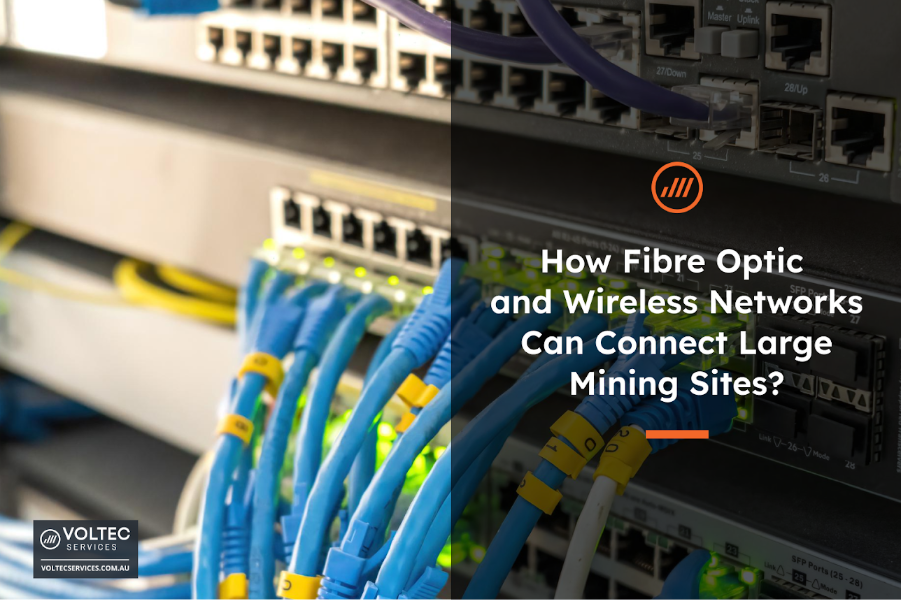
Reliable connectivity is no longer a convenience on modern mining sites; it is critical infrastructure. From autonomous equipment and CCTV monitoring to communications, environmental sensors, and operational reporting, mining operations rely on networks that can perform across vast, demanding environments.
However, connecting workshops, processing plants, administration buildings, remote assets, and field operations across large sites requires more than a single networking solution. By combining fibre optic infrastructure with wireless network technologies, mining businesses can create scalable, resilient communication networks that support productivity, safety, and long-term operational performance.
Why Do Large Mining Sites Need Hybrid Network Infrastructure?
Mining operations rarely operate from a single building. Critical infrastructure is often spread across kilometres, with operational areas expanding as projects develop.
Traditional copper cabling alone cannot efficiently support long-distance, high-bandwidth communication across these environments. A hybrid approach, using fibre optic cabling as the network backbone and wireless technologies to extend coverage, allows businesses to connect fixed infrastructure and remote locations while maintaining reliable communication across the site.
How Does Fibre Optic Infrastructure Support Mining Operations?
Fibre optic cabling forms the foundation of a high-performance industrial network. Unlike conventional cabling, fibre is designed to carry large volumes of data over long distances while maintaining signal quality, making it well suited to extensive mining environments.
A professionally planned fibre optic installation can support:
- Operational communications
- CCTV and security systems
- Control rooms
- Process monitoring
- Data transfer between facilities
- Future network expansion
Professional splicing, testing, and commissioning also help preserve signal integrity and minimise attenuation, supporting long-term network reliability.
What Role Do Wireless Networks Play Across Remote Areas?
While fibre provides exceptional performance between permanent infrastructure, wireless solutions become valuable where physical cabling is impractical or cost prohibitive.
Point-to-point and point-to-multipoint radio links can connect remote workshops, water infrastructure, monitoring stations, and temporary operational areas without extensive trenching. These wireless links can also support internet backhaul, remote monitoring, and critical operational communications across challenging terrain.
This flexibility allows mining businesses to expand connectivity as operational requirements evolve.
How Can Integrated Networks Improve Operational Efficiency?
A well-designed network allows multiple systems to work together through a single communication infrastructure.
Instead of operating separate networks for security, communications, and operational data, businesses can integrate technologies such as CCTV, network hardware, Wi-Fi coverage, and monitoring systems into a coordinated environment. This simplifies management while improving visibility across the entire site.
Integrated infrastructure also reduces unnecessary duplication and supports more efficient long-term network management.
Why Should Scalability Be Considered During Network Design?
Mining projects rarely remain static. New buildings, processing facilities, workshops, and remote assets often require additional connectivity as operations expand.
Designing scalable fibre optic and wireless infrastructure from the outset allows businesses to accommodate future growth without rebuilding their entire network. This protects infrastructure investment while reducing disruption during future upgrades.
How Can Professional Network Installation Reduce Long-Term Risk?
Industrial networks require precision during design, installation, testing, and commissioning. Proper cable routing, fibre termination, radio alignment, network hardware configuration, and performance testing all contribute to reliable long-term operation.
Working with experienced fibre optic installers can help ensure that critical infrastructure is installed and tested according to the requirements of the site and its operating environment.
Why Should Mining Businesses Choose Voltec’s Expert Solutions?
Connecting large mining sites requires a strategic combination of high-performance fibre infrastructure and reliable wireless technologies tailored to demanding industrial environments.
As a full service electrical contractor, Voltec provides mining businesses across North Queensland with integrated solutions covering network design, installation, testing, and commissioning. Its capabilities include fibre backbone installation, wireless radio links, and complete network infrastructure designed to support long-distance connectivity, operational efficiency, and future growth.
Choose Voltec’s expert solutions to build a resilient network that keeps your mining operations connected today while supporting tomorrow’s expansion.
FAQs
Why is fibre optic cabling suitable for large mining sites?
Fibre optic cabling supports high-bandwidth communication over long distances while maintaining excellent signal quality. It provides a reliable backbone for connecting critical infrastructure across large industrial sites.
How do wireless radio links complement fibre networks?
Radio links extend connectivity to remote locations where physical cabling is impractical. They support communications, monitoring systems, internet backhaul, and operational data transmission across expansive sites.
Can fibre and wireless networks work together?
Yes. Fibre typically serves as the primary network backbone, while wireless technologies extend coverage to remote assets, creating a flexible and scalable communication infrastructure.
What mining systems can operate on an integrated network?
Integrated networks can support CCTV, operational communications, Wi-Fi, process monitoring, network hardware, control rooms, and other business-critical systems through a unified infrastructure.
Why is professional testing important after network installation?
Professional testing verifies signal integrity, fibre performance, radio alignment, and overall network reliability. This helps ensure the infrastructure performs as expected while reducing future connectivity issues.